

One tank game, a full coordination loop
How one browser-game request moved through research, design, implementation, review and two correction rounds.
A user asked: “Create a browser-based tank battle game that recreates the full original experience.” The record dates to 18 September 2026. One software-delivery squad owned the task.
This case illustrates coordination and revision. It is not a cost comparison, success-rate benchmark, or proof of exact original-game fidelity.
What happened
| Work | What it produced or checked |
|---|---|
| Intent, requirements and source research | 19 acceptance requirements; a reference version, gameplay rules and scope boundaries |
| Architecture, workload and interface design | Module/data contracts, an impact assessment, pixel layout and interface states |
| Implementation and integration | A browser game with terrain, enemies, power-ups, scoring, two-player play and construction mode |
| Independent testing | Game rules, data and playable flows |
| Interface-integrity review | Real browser observations, screenshots and interaction evidence |
| System-integrity review | Whether the delivery and evidence supported the requirements |
| Orchestrator | Connected the work, collected artifacts and recorded delivery limits |
These responsibilities overlapped as dependencies allowed. This table is a logical account, not a measured concurrency chart.
Two rounds of correction
Scoring and results. Review led back to implementation to repair cumulative scoring across stages and results presentation. The closing record describes rechecking the score after advancing a stage.
Stage data. The operator required original-style maps from a public, non-ROM source. The implementation replaced 35 maps and enemy rosters, recorded their provenance, then returned the data for independent checking. This intervention is part of the case.
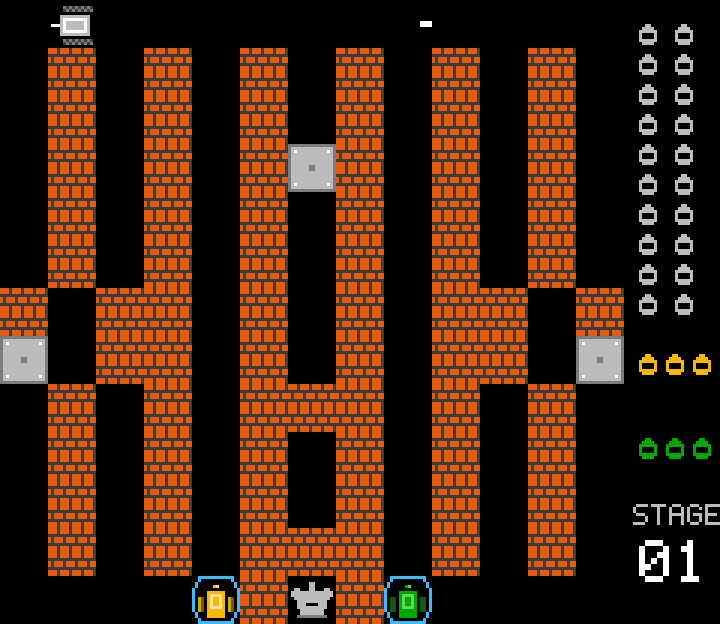
The image is a retained screenshot of the delivered game, not the OpenCorvus interface or a new acceptance run.
What remains uncertain
The closing narrative says 242 tests passed. A retained report says 241 passed and one failed; its revision relative to the final delivery has not been reconciled. We do not advertise a full pass.
The maps are traced to public remake data, not independently proven equivalent to the original game’s read-only memory (ROM) data. Partial terrain cells, individual enemy order and later-loop composition have documented simplifications. Some live-play evidence, including the high-score screen and actual shovel pickup, was missing. A completed task state does not remove those limits.
Inspect the evidence
Selected source excerpts and file fingerprints contain the requirement breakdown, Mission repair notes, observed role names and retained test totals. These selected local records are not a complete public transcript; fingerprints identify the inspected bytes without making the private originals publicly available.
To try a similar workflow, configure OpenCorvus, then select a software-delivery squad and give it a bounded goal with explicit acceptance criteria. The runtime and provider must remain available.